Opéra de Paris
Illusions perduesThe Opéra de Paris becomes a public threshold between Lucien de Rubempré’s provincial ambitions and the Parisian society he hopes to enter. On his first visit, elegant clothes and an aristocratic name seem to promise admission, yet both the theatre’s entrance and the company in its box reveal the limits of appearances. The place matters not simply as a venue for a performance, but as a space where status is displayed, assessed, and withheld in full view.
Arrival and the Test at the Entrance
Lucien reaches the Opéra in the evening after deciding that the clothes he owns will not do before Madame d'Espard. He returns to his lodging for money, then shops at the Palais-Royal, where the components of his intended elegance are scattered across different trades. A tailor sells him a green coat, white trousers, and a fancy waistcoat for two hundred francs; he also finds elegant boots and has the rest of his purchases brought to his room by their suppliers. At seven, dressed and curled, he takes a hired carriage to the theatre. The new clothes make him feel constrained, as though he is wearing an unfamiliar case around himself.
Following Madame de Bargeton’s recommendation, Lucien asks for the box of the First Gentlemen of the Chamber. The Controller asks to see his ticket; Lucien has none, and is bluntly told that he cannot enter. His confidence in the social access implied by his introduction and his borrowed name meets the practical authority of the doorway. The episode makes the Opéra’s entrance a first test: money has bought an outfit, but it has not bought the right to pass.
The Box and Its Public Visibility
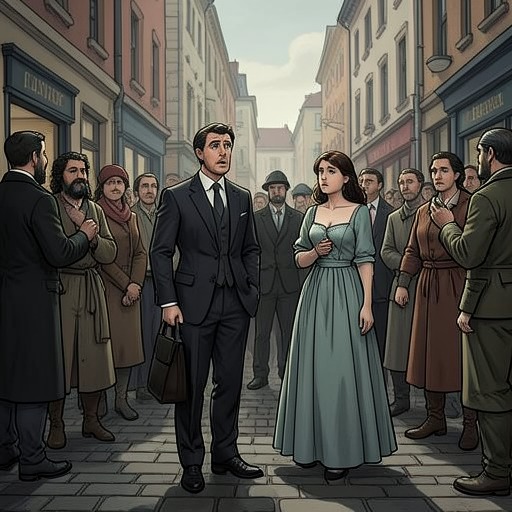
A carriage stops beneath the portico, and two dressed women emerge. Lucien makes way for them rather than risk another rebuke from the Controller. The Controller then ironically points out that one of the women is Madame d'Espard, whom Lucien had claimed to know. The moment turns his uncertain position into a public embarrassment. Madame de Bargeton, however, smiles when he approaches and invites him to come with her; the officials at once become serious again, and the man who had been refused follows her up the broad staircase.
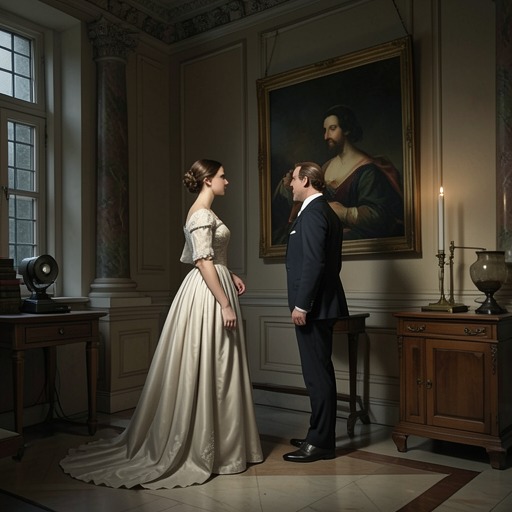
The box of the First Gentlemen is situated in one of the two angled corners at the back of the auditorium. From there, its occupants can be seen from every side while also seeing the rest of the house. The description gives the box a double function: it offers a place from which to watch, but makes its occupants part of the spectacle too. At first Lucien sits behind Madame de Bargeton, on a chair and in the shadow, relieved not to be exposed. Madame d'Espard addresses him as Monsieur de Rubempré and tells him to take the seat at the front. Her invitation moves him from concealment into view, where his presentation and his company can be judged.
A Salon Compressed into the Theatre
The box brings together figures whose social and literary standing makes Lucien’s inexperience conspicuous. Madame de Bargeton sees that Madame d'Espard gives him little attention. As conversation begins, the assembled company displays a quickness and depth of conversation that, in the narrator’s comparison, exceed what Madame de Bargeton hears in the provinces over a month. The contrast changes Lucien’s apparent importance: among these people, the provincial newcomer seems like a stranger who does not know the language of the room.
Madame d'Espard introduces him to Canalis, presenting him as a beginner from Angoulême who may need protection from those who bring genius to public notice. Her appeal acknowledges Canalis’s high position in the literary world, but also frames Lucien as a possible object of patronage rather than as an equal. She challenges the assembled men to help him through friendship, whereas they ordinarily advance rivals through hatred. Their attention briefly turns to Lucien, but that attention does not amount to acceptance. Henri de Marsay studies him through an eyeglass and compares him with Madame de Bargeton in a way that wounds them both; Félix de Vandenesse looks charitable, while Armand de Montriveau regards Lucien as if testing how far down he goes. The box thus functions as a small arena of social judgment, where even a glance can mark the distance between established figures and an aspirant.
Abandonment and the Meaning of Admission
At the Opéra, Madame de Bargeton begins to understand the warning Sixte du Châtelet had given her: beside the company around Canalis, Lucien appears to count for nothing. Madame d'Espard takes pity on his isolation, but her sympathy does not settle his position. During the third act, Lucien watches the spectacle while continuing to dream about Madame d'Espard and the new love he imagines pursuing. When he turns to look for her, he finds that she has left with her cousin; the door is closing, and he has been abandoned in the box without an explanation he can understand.
Once they are in the carriage, Madame d'Espard reproaches her cousin for taking an interest in the son of an apothecary before he has actually become famous. Madame de Bargeton privately feels fortunate that she had kept Lucien at a distance and granted him nothing. The theatre’s momentary admission therefore opens into a social rejection: Madame de Bargeton can bring him past the Controller and into the box, but cannot make his provincial origins disappear or secure him a place among the people assembled there. The Opéra’s progression—from blocked entrance, to a seat in public view, to an empty box after the women depart—gives physical shape to the difference between being introduced to high society and being accepted by it.